| ||||||||||
| Tree with the fern Fractal created by Jenny She used Fractal Explorer
|
Latest Posts
Showing posts sorted by relevance for query INCENDIA. Sort by date Show all posts
Showing posts sorted by relevance for query INCENDIA. Sort by date Show all posts


 |
| Snowwdrops Fractal created by Krys She used Incendia Galanthus (snowdrop) is a small genus of approximately 20 species of bulbous perennial herbaceous plants in the family Amaryllidaceae. The plants have two linear leaves and a single small white drooping bell shaped flower with six petal-like (petaloid) tepals in two circles (whorls). The smaller inner petals have green markings. |
When the spring starts its activity, weed are visible at once on the surface of the ground. They are usually small, delicate and so beautiful but it's very hard to throw they our gardens out. Nor from OFG:(
Is not sonchus arvensis beautiful?

Dandelion. Fractal created by Lynn. She used Fractal Explorer.
Sonchus arvensis, the field milk thistle, field sowthistle, perennial sow-thistle, corn sow thistle, dindle, gutweed, swine thistle, or tree sow thistle, is a species of flowering plant in the daisy family Asteraceae. S. arvensis often occurs in annual crop fields and may cause substantial yield losses.

The plant grows up to 1.5 metres in height, with leaves 10-35 cm long and 4–14 cm wide.It produces conspicuous yellow flowerheads about 3–5 cm
wide, which are visited by various types of insects—especially hoverflies of the genus Eristalis.
Sonchus arvensis is native to Europe, where it is widespread across most of the continent. It has also become naturalized in many other regions, and is considered an invasive noxious weed in some places, such as North America (including Prince Edward Island), Russia, New Zealand, United Kingdom and Australia.
It grows in areas such as pastures, roadsides, bushlands and the shorelines of lakes, rivers and sea coast.
USES
The young leaves, when less than a few inches long and not bitter in taste, can be mixed with other greens to make salad. They can also be boiled in a small quantity of water, changed once. The plant can contain toxic nitrates.
 |
| Forget-me-not Fractal created by Krys used Incendia |
Mysotis is a genus of flowering plants in the family Boraginaceae. In the northern hemisphere they are colloquially denominated forget-me-not] or Scorpion grasses.
 |
| Photo taken by Lynn |
- The colloquial name "Forget-me-Not" was calqued from the German Vergissmeinnicht
- first used in English in AD 1398 through King Henry IV of England. Similar names and variations are found in many languages.
- Myosotis alpestris is the official flower of Alaska and Dalsland, Sweden.
In a German legend, after the earth was created, God went to each plant and animal and gave each a name. As God finished and was getting ready to leave, he heard a little voice at his feet saying “what about me?” He bent down and picked up the little plant whom he had forgotten, and said “Because I forgot once, I shall never forget you again, and that shall be your name.”
The Christ Child was sitting on Mary's lap one day and said that he wished that future generations could see her eyes. He touched her eyes and then waved his hand over the ground and blue forget-me-nots appeared, hence the name forget-me-not.
 |
| Rudbeckia fractal created by Krys used Incendia |
 |
| Black Eyed Susan fractal created by Lynn used Fractal Explorer Rudbeckia is a plant genus in the sunflower family. The species are commonly called coneflowersand black-eyed-susans; all are native to North America and many species are cultivated in gardens for their showy yellow or gold flower heads.
|

Fractal created by Krys. She used Incendia.
Convolvulus /kənˈvɒlvjuːləs/ is a genus of about 200 to 250 species of flowering plants in the bindweed family Convolvulaceae, with a cosmopolitan distribution. Common names include bindweed and morning glory; both names shared with other closely related genera
They are annual or perennial herbaceous vines, bines and (a few species of) woody shrubs, growing to 0.3–3 m tall. The leaves are spirally arranged, and the flowers trumpet-shaped, mostly white or pink, but blue, violet, purple, or yellow in some species.
Many of the species are invasive weeds; but others are cultivated for their attractive flowers, while some are globally threatened.
Convolvulus species are used as food plants by the larvae of some Lepidoptera species, including the convolvulus hawk moth, the sweet potato leaf miner (Bedellia somnulentella) and the gem; the leaf miner Bucculatrix cantabricella feeds exclusively on C. cantabricus.

Jaskier polny/Ranuculus arvensis. Fractal created by Krys. She used INCENDIA
Ranunculus arvensis, the corn buttercup, devil-on-all-sides or scratch bur, is a plant species of the genus Ranunculus. It is native to Europe, but it can be found on other continents as an introduced species and sometimes a weed, including in North America and Australia. It was formerly a common annual arable weed in Britain, but is now rare there. It is most often found in moist places, such as spring puddles in meadows.
 |
| Matricaria chamonilla Fractal created by Krys Used Incendia Matricaria chamomilla (synonym: Matricaria recutita), commonly known as chamomile (also spelled camomile), Italian camomilla, German chamomile, Hungarian chamomile (kamilla), wild chamomile or scented mayweed, is an annual plant of the composite family Asteraceae. M. chamomilla is the most popular source of the herbal product chamomile, although other species are also used as chamomile
-as a gentle sleep aid. It is also used -s a mild laxative and is anti-inflammatory. -as an herbal tea, two teaspoons of dried flower per cup of tea, which should be steeped for 10 to 15 minutes while covered to avoid evaporation of the volatile oils. The marc should be pressed because of the formation of a new active principle inside the cells, which can then be released by rupturing the cell walls, though this substance only forms very close to boiling pointa -a sore stomach, some recommend taking a cup every morning without food for two to three months
Chamomile can cause allergy symptoms and can cross-react with ragweed pollen in individuals with ragweed allergies. It also contains coumarin, so care should be taken to avoid potential drug interactions. |

Coccinelldae. Fractal created by Krys used Incendia and Lynn's pic from Internet Exporer.
Coccinellidae is a widespread family of small beetles ranging in size from 0.8 to 18 mm. The family is commonly known as ladybugs in North America and ladybirds in Great Britain and other parts of the English-speaking world. Entomologists prefer the names ladybird beetles or lady beetles as these insects are not classified as true bugs.
The majority of the more than 6000 described species are generally considered beneficial insects, because many prey on herbivorous hemipterans such as aphids or scale insects, which are agricultural pests. Many coccinellids lay their eggs directly in aphid and scale insect colonies in order to ensure their larvae have an immediate food source. However, some species do have unwelcome effects; among these, the most prominent are of the subfamily Epilachninae (which includes the Mexican bean beetle), which are herbivorous themselves. Usually, epilachnines are only minor agricultural pests, eating the leaves of grain, potatoes, beans, and various other crops, but their numbers can increase exponentially in years when their natural enemies, such as parasitoid wasps that attack their eggs, are in fewer numbers. In such situations, they can do major crop damage. They occur in practically all the major crop-producing regions of temperate and tropical countries.
Coccinellids are often conspicuously coloured yellow, orange, or red with small black spots on their wing covers, with black legs, heads and antennae. There is, however, great variation in these colour patterns. For example, a minority of species, such as Vibidia duodecimguttata, a twelve-spotted species, have whitish spots on a brown background. Coccinellids are found worldwide, with over 6,000 species described.
Most coccinellids have round to elliptical, dome-shaped bodies with six short legs. Depending on the species, they can have spots, stripes, or no markings at all. Seven-spotted coccinellids are red or orange with three spots on each side and one in the middle; they have a black head with white patches on each side.
As well as the usual yellow and deep red colourings, many coccinellid species are mostly, or entirely, black, dark grey, gray, or brown.

Fractal created by Krys with Incendia
Fuchsia ( /ˈfjuːʃə/) is a genus of flowering plants that consists mostly of shrubs or small trees. The first to be scientifically described, Fuchsia triphylla, was discovered on the Caribbean island of Hispaniola (Haiti and the Dominican Republic) about 1696–1697 by the French Minim monk and botanist, Charles Plumier, during his third expedition to the Greater Antilles. He named the new genus after German botanist Leonhart Fuchs (1501–1566).
Almost 110 species of Fuchsia are recognized; the vast majority are native to South America, but a few occur north through Central America to Mexico, and also several from New Zealand to Tahiti. One species, F. magellanica, extends as far as the southern tip of South America, occurring on Tierra del Fuego in the cool temperate zone, but the majority are tropical or subtropical. Most fuchsias are shrubs from 0.2 to 4 m tall, but one New Zealand species, the kōtukutuku (F. excorticata), is unusual in the genus in being a tree, growing up to 12–15 m tall.
Fuchsia leaves are opposite or in whorls of three to five, simple lanceolate, and usually have serrated margins (entire in some species), 1–25 cm long, and can be either deciduous or evergreen, depending on the species. The flowers are very decorative; they have a pendulous teardrop shape and are displayed in profusion throughout the summer and autumn, and all year in tropical species. They have four long, slender sepals and four shorter, broader petals; in many species, the sepals are bright red and the petals purple (colours that attract the hummingbirds that pollinate them), but the colours can vary from white to dark red, purple-blue, and orange. A few have yellowish tones. The ovary is inferior and the fruit is a small (5–25 mm) dark reddish green, deep red, or deep purple berry, containing numerous very small seeds.
The fruit of the berry of F. splendens is reportedly among the best-tasting. Its flavor is reminiscent of citrus and black pepper, and it can be made into jam. The fruits of some other fuchsias are flavorless or leave a bad aftertaste.
 |
| Wild Flowers Fractal created by Krys She used Fractal Explorer |
 |
| Wild Flowers Fractal created by Krys She used Fractal Explorer |
 |
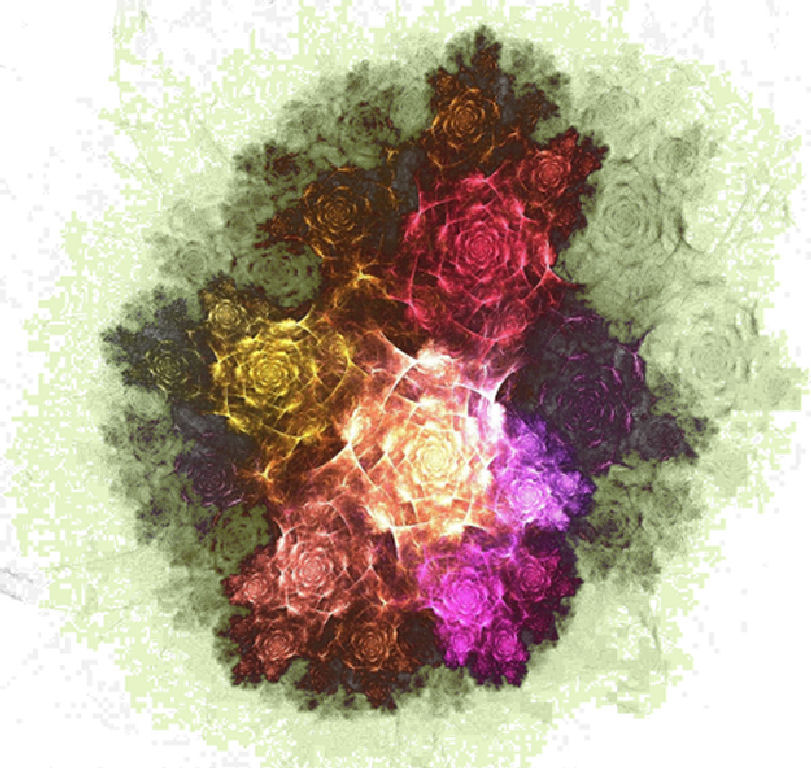
| Bush of flowers Fractal created by Krys She used Incendia |
Wild flower is a flower that grows in the wild. Wildflowers aren't naturally planted by nature or by humans, but grow in the wild.
Wildflowers are native and exotic species. Some species of wildflowers are endangered.
There are so many different wild flowers everywhere we go..
..
 |
| Fauna and flora Fractal created by Jenny She used Fractal Explorer |
Wild flower is a flower that grows in the wild. Wildflowers aren't naturally planted by nature or by humans, but grow in the wild.
Wildflowers are native and exotic species. Some species of wildflowers are endangered.
There are so many different wild flowers everywhere we go...
.
 |
| Wild Flowers western Australia By Raygday - Own work, CC BY-SA 3.0, httpscommons.wikimedia. |
 | ||
| Nascissus Fractal created by Krys She used Incendia
|

 | ||||||||
| Heather Fractal created by Jenny She used Fractal Explorer
|


 | ||||||||||||||
| Winter Rose Fractal created by Louise She used Fractal Explorer
|